
November is when the year starts closing in fast for anyone running a work truck. Holiday deliveries pick up, rental and moving demand spikes, crews are stretched thin, and the last thing anyone wants in December is a registration renewal that can't go through because a truck still needs its smog check. If you run a box truck, a service van, or a small fleet out of Simi Valley, now is the easiest time of year to get emissions compliance off your list.
The tricky part is that "smog check" doesn't mean the same thing for every truck. Depending on fuel type and weight, your vehicle may fall under California's regular Smog Check program, CARB's Clean Truck Check program, or both on different units in the same fleet. Here's how to sort it out before the holidays.
Gas-powered trucks of any size go through the regular Smog Check program every two years. Diesels at 14,000 lbs GVWR or less (1998 and newer) do too. Diesel and alternative-fuel trucks over 14,000 lbs GVWR fall under CARB's Clean Truck Check instead, which currently requires testing twice a year. A smog certificate is good for 90 days, so testing in November covers renewals coming due through the end of January.
Why November is the right time to test
There are a few practical reasons to handle truck emissions now instead of waiting for the renewal notice to turn urgent:
- The 90-day window works in your favor. A passing smog certificate is valid for 90 days. Test a truck in early November and that certificate still covers a registration renewal due in late January, so year-end and first-of-year renewals can all be cleared in one trip.
- You get time to fix a failure. If a truck fails, you need time to get it repaired and re-tested. Finding that out in November means repairs happen before the holiday shutdowns, not during them.
- December is the worst month to lose a truck. A registration hold during peak delivery or rental season costs a lot more than the test. Getting it done early keeps the truck earning when it matters most.
- Clean Truck Check deadlines don't wait. For heavy-duty diesels, compliance deadlines are tied to your registration date, and tests can be submitted up to 90 days ahead. If a deadline lands in December or January, you're already inside that window.
Gas or diesel? Which program your truck falls under
This is where most of the confusion comes from. Weight and fuel type decide which test your truck needs:
- Gasoline trucks, any weight (1976 and newer): Regular California Smog Check, every two years at registration renewal, plus on change of ownership. Gas trucks are exempt for their first eight model years, then the biennial check kicks in. Unlike diesels, there's no weight cutoff for gasoline vehicles, so a gas-powered box truck over 14,000 lbs still gets a standard smog check.
- Diesel trucks 14,000 lbs GVWR or less (1998 and newer): Regular Smog Check as well. This covers most diesel pickups, cargo vans, and lighter commercial trucks. See our Diesel & Hybrid Smog page for details.
- Diesel, alternative-fuel, and hybrid trucks over 14,000 lbs GVWR: CARB Clean Truck Check, not regular Smog Check. These trucks currently test twice a year, with deadlines tied to the registration date. If your trucks aren't set up in CARB's system yet, start with our step-by-step guide, How Do I Register My Diesel Vehicle With CARB?
Not sure of your truck's weight rating? Look for the GVWR on the sticker inside the driver's door jamb.
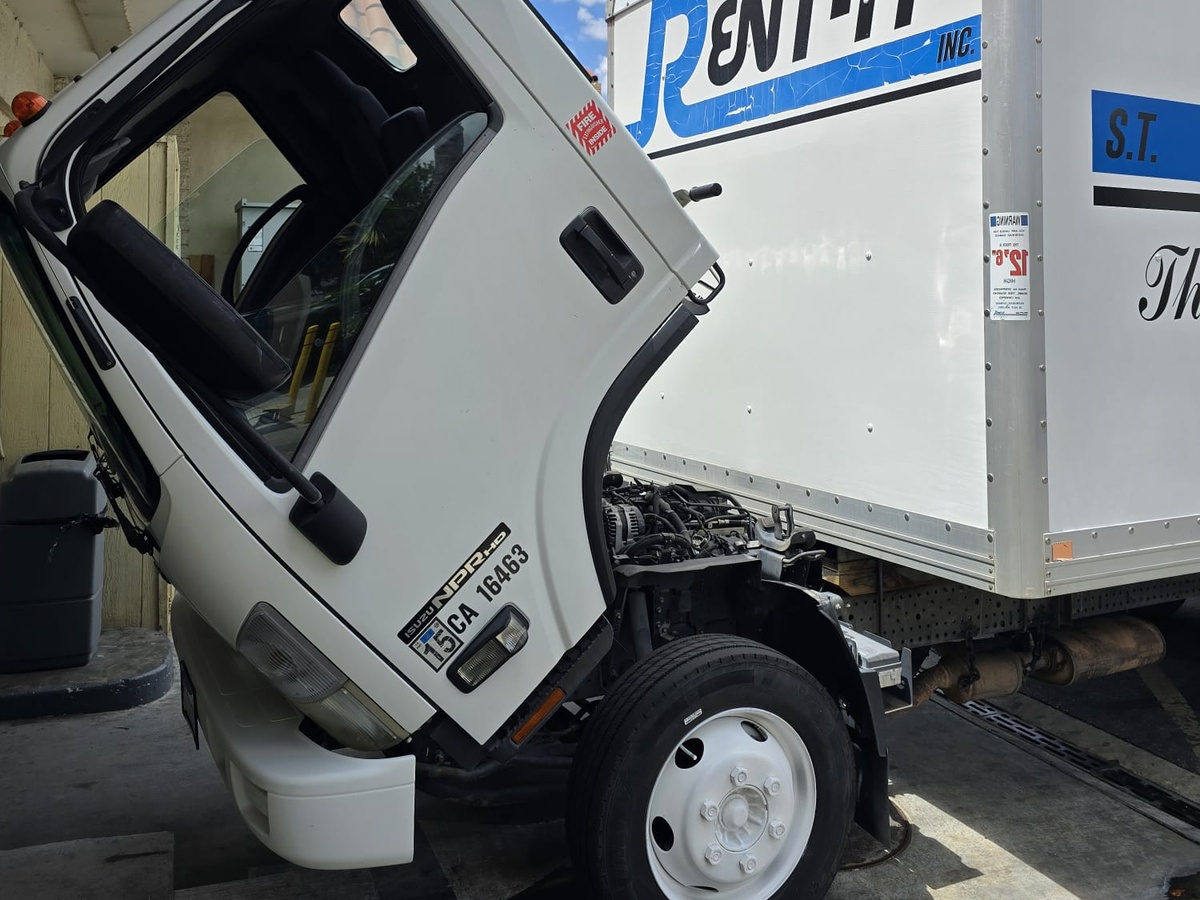
Why the cab is tilted in this photo
On a car, the technician pops the hood. On cab-over trucks like the box truck pictured above, the engine sits underneath the cab, so the whole cab often tilts forward to give a clear view of the engine bay. Part of every smog check is a visual inspection: the technician confirms the required emission control components are present, connected, and not tampered with. On these trucks, that means getting eyes on the engine itself.
It looks dramatic, but it's routine. It's simply how the inspection is done on this style of truck, and it's one reason it helps to call ahead when you're bringing in something bigger than a pickup.
Before you bring your work truck in
The usual smog prep applies to trucks too: the check engine light needs to be off, and the engine should be warmed up. Our guide How to Pass Your Smog Check the First Time covers the full list. For work trucks specifically, keep these in mind:
- Don't clear codes or swap the battery right before testing. Either one resets the onboard computer's readiness monitors, and the truck can't pass until a few days of normal driving set them again. This catches a lot of fleet trucks that just came back from the shop.
- Know your truck's height. If you're bringing in a tall box truck, mention it when you call so we can plan the bay.
Running a small fleet? Batch it
If you manage several trucks, pull every unit's registration expiration date and look at what's coming due between now and spring. Anything renewing in the next 90 days can be tested now. Grouping trucks into one or two scheduled visits is far less disruptive than reacting to renewal notices one at a time, and it gives you a clear picture of any repair needs before the new year.
For mixed fleets, sort your trucks into the two programs first: gas and lighter diesels on the Smog Check list, heavier diesels and alternative-fuel trucks on the Clean Truck Check list. We handle both at our Sycamore Drive location, and for Clean Truck Check we can also come to you within about 20 miles of Simi Valley.
A few common questions
My box truck is gas-powered and over 14,000 lbs. Do I need Clean Truck Check? No. Clean Truck Check covers diesel, alternative-fuel, and hybrid trucks over 14,000 lbs GVWR. Gasoline-only trucks stay in the regular Smog Check program, regardless of weight.
Can I test now if my registration isn't due until January? Yes. A smog certificate is valid for 90 days and is sent electronically to the DMV, so a November test covers a renewal that comes due within that window.
What if my DMV notice says STAR station required? Then the certificate has to come from a STAR station. We're STAR Certified, so any directed vehicle qualifies here. Our guide What Is a STAR Smog Check? explains why vehicles get directed.
What happens if the truck fails? You'll get a report showing exactly what failed. We're a test-only station, so we don't do repairs, which means we have no reason to find problems that aren't there. Get the truck repaired, then bring it back to re-test. With our coupon, a re-test within 30 days is free.
The bottom line
The weeks before the holidays are the easiest time to get a work truck's emissions squared away. Figure out which program each truck falls under, test anything renewing in the next 90 days, and leave yourself room to handle a failure before the shops close for the holidays. A little planning in November keeps your trucks registered, on the road, and earning through December.
Need a smog check for a work truck, van, or fleet vehicle in Simi Valley? We're a STAR Certified, test-only station handling regular Smog Check and CARB Clean Truck Check, serving Simi Valley, Moorpark, Thousand Oaks, Chatsworth, and surrounding areas. Grab our $10 off coupon, call (805) 526-9716 to let us know what you're bringing in, or drive in to 2405 Sycamore Dr.